Tarot spreads are an incredibly effective tool in unlocking hidden wisdom and understanding unconscious processes within ourselves. Using a spread, the cards paint a story that can provide insight into our lives and helps us answer pressing questions. Of course, the way we approach a reading can greatly affect the outcome.
Begin the exercise of reading your cards in a relaxed and receptive state of mind. It’s best to avoid an analytical mindset and instead open ourselves to spiritual messages that may come in irrational forms. This is why meditation or ritual can be helpful in achieving the right state of mind for tarot.
Tarot spreads can be used to reveal hidden factors about a situation. They can be tailored to specific questions or decisions. The symbolism in each card holds spiritual significance that, by reading the context of the other cards, can speak to you on a deep level.
The following list of tarot spreads is a roadmap for those looking to delve deeper into the universal consciousness. These layouts were developed by different experts over time and deliver accurate, pragmatic readings. While the descriptions below were written for tarot spreads, they can also be used for other oracle layouts.
Definition
A tarot card spread is a template that a reader uses to arrange the cards. Each tarot card is interpreted normally plus by its layout position, including the way the influence of this card may bleed into the meaning of each card adjacent to it.
Elemental Dignity vs Reversals
With tarot decks on this site that do not use reversals, the traditional occult method of determining elemental dignity can be used to determine whether each card is well-dignified or ill-dignified. The dignity of each tarot card is based on how the adjacent cards relate to it. Each tarot card is interpreted one at a time to determine its dignity, meaning how it is affected by its neighbours. Adjacent cards of the same suit strengthen a card’s dignity, providing a sort of power boost to the card’s appeal. Tarot cards of directly opposite suits reverse each other’s positive charge, causing ill-dignification. For example, if a cups card had a wands card next to it, this would rub the cups card the wrong way and cause it to become ill-dignified. (Wands are the opposite of cups, and swords are the opposite of pentacles.) Cards that are not of the opposite or the same suit are considered neutral and have no effect (such as a wand next to a sword or a sword next to a cup). Major Arcana can sometimes be disregarded as they don’t always correspond to a particular element (fire, water, air, earth) as Minor Arcana cards do. The Golden Dawn method is the spread that relies most heavily on elemental dignities.
Since Rider-Waite-inspired decks generally use reversals, this makes it easy to interpret each card’s dignity, which is not affected by adjacent cards but by its own orientation, as in facing up or down. Traditionally, reversed card meanings were not used much in tarot reading until after the ground-breaking Rider-Waite deck incorporated them. Reversals were introduced by Etteilla, who published the first material on cartomancy reversals in 1770 – using a deck of 32 cards (perhaps influencing Madam Lenormand). Reversals are not an option with several decks simply because the artist did not intend for their creation to be read with reversals, and that being the case, they did not write reversed meanings.
On the other hand, one may decide to disregard the elemental dignities if they are too much trouble. Of course, it is best to interpret the cards according to one’s personal perspective, gaining understanding through one’s own methods of learning. Suggestions on how to read tarot cards using elemental dignities and such as presented on this site should serve merely as a guideline, not as a rule. Each reader should come to understand tarot reading through diligent practice, weighing the interpretations by their own standards.
Simple Layouts
One-Card Tarot Reading
Difficulty: Easiest
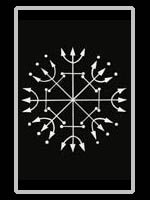
The one-card tarot reading is best for times when focusing on just one thing without any potential complications is desirable. It can be used for just about any question, including drawing a card of the day, week, or even one’s card of ultimate destiny. It can also be used repetitively, as some readers prefer to pull one card at a time, watching as a story unfolds. There are even some readers who don’t use tarot spreads at all, relying on this method alone.
Past, Present, and Future Spread
Difficulty: Very easy
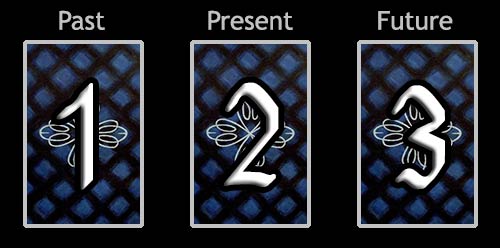
This simplistic chronological spread can be used to shed light on the influences that have passed, current influences, and what is approaching in the near future. Not much explanation is necessary for this simple tarot spread.
The Blind Spot
Difficulty: Varies
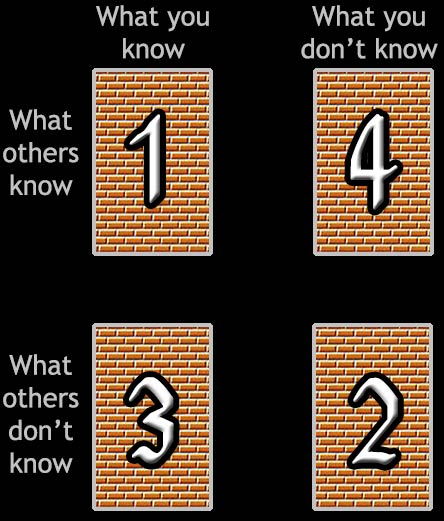
This tarot spread is used to enhance self-awareness. Questions about learning something about oneself or things that are hidden work very well with this tarot spread, although no question is necessary.
- This tarot card displays the obvious identity, the part of oneself that is consciously known and projected to others.
- This card indicates unconscious driving forces that neither the reader nor others are aware of about them, the great unknown. Nobody knows what this tarot card means, at least not yet…
- The part of oneself that is concealed, to keep others from discovering, is apparent in this card.
- This is the Blind Spot. This is what was asked about, that which this reading should bring awareness of. The reader may wish to pay close attention to these mannerisms.
The Cross
Difficulty: Easy
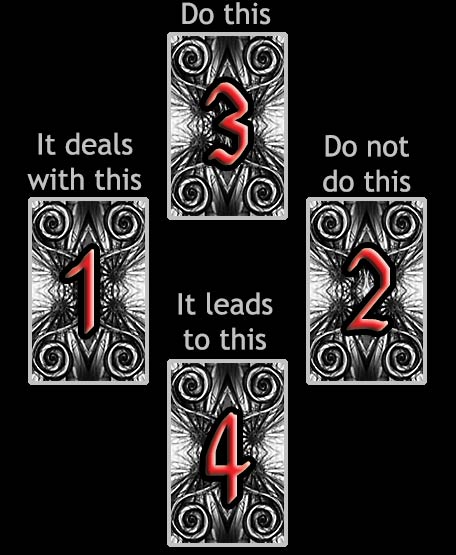
The Cross Spread is good for questions and advice. It can also be used to determine the meaning of a confusing card from a previous reading, or for that matter, to shed light on other points of confusion.
In questions asking advice, this tarot spread is self-explanatory. The main thing is to determine the difference between cards #2 and #3. #1 is the topic and #4 is the result.
In questions regarding confusion, such as: “What was the meaning of Card (X) in the last spread?” the main thing is also to determine the difference between cards #2 and #3. In this case, #2 will show what the card was not referring to, and Card #3 will show what was really meant. Card #1 is the topic and #4 represents the purpose it serves.
The Horse Shoe
Difficulty: Easy
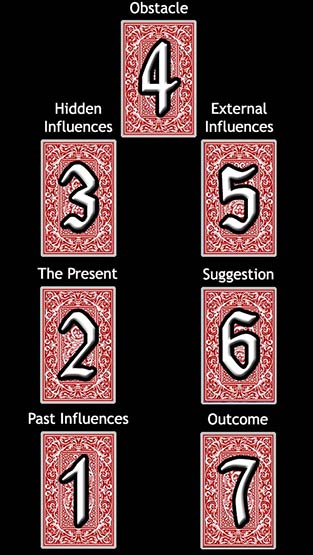
The Horse Shoe is a classic tarot spread. It is more advanced than the three-card reading, yet simpler than most other spreads. It is a versatile method that can be used for most queries, though there are other spreads that would go into more depth. As the simple Past, Present, and Future spread, it contains these cards in positions #1, #2, and #7, but also has four other tarot cards that help the reader understand how to deal with the future better. The cards are to be read as follows:
- The Past: Past events affecting the question.
- The Present: The current state or approaching influence.
- Hidden Influences: Things the reader may not be aware of (or barely be aware of).
- Obstacles: This is the challenge: obstacles may be avoided or may have to be dealt with.
- External Influences: Attitudes and thoughts regarding people around the reader.
- Suggestions: Recommended course of action.
- Outcome: The result of following the suggestions.
The Ankh Spread
Difficulty: Kind of tough
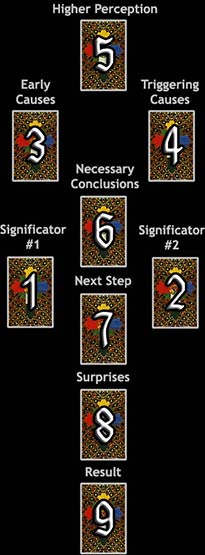
The Ankh Spread is for questions about the causes behind trends. It is similar to the Celtic Cross and Secret of the High Priestess spreads, but it covers the reasons behind the circumstances in question differently, perhaps giving a better explanation of why things are the way they are.
The loop of the upper section of the ankh reveals the spiritual background and causes of the situation, while the stem of the base focuses on prospects for the outcome.
The first two tarot cards represent the two parent causes of the situation. They will either complement each other or show two opposing sides of a conflict, depending on how they relate. These are the significator cards of the Ankh spread.
3. This tarot card shines light upon the early causes of the trend in question.
4. Pinpoints the causes that triggered the current situation.
5. Reveals the spiritual perspective of the subject at hand.
6. This card examines the reasons why this course of action had to unfold, as a means to this end.
At this point, it is good to pause to soak in the meaning of the first six cards before moving forward to the last three cards. The last three reveal prospects for the future.
7. The Next Step gives clues about the immediate future.
8. Surprising Experiences encountered en route to the result.
9. This represents the result.
The Celtic Cross
Difficulty: Average
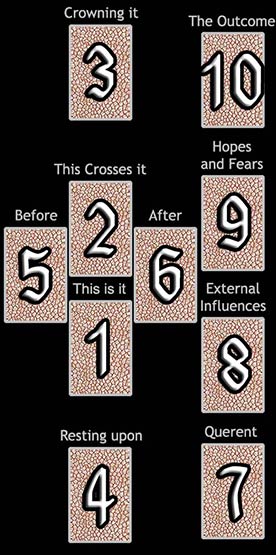
This is probably the most well-known tarot spread. A good, basic spread for beginners to practise with, the Celtic Cross is useful for questions of all types. In this spread, it can be helpful to notice the relationships between the pairings of cards #5 & #9, #1 & #2, #3 & #4, and #6 & #10.
- The significator epitomizes what the reading deals with, the initial situation.
- An added impulse that compounds the significator, which may be either complimentary or contradictory.
- This is what is consciously known (thoughts).
- Unconscious driving forces that may not be known fully (emotions).
- The immediate past regarding the current situation.
- The first future card indicates the immediate future.
- This card represents the reader and their attitude towards cards #1 and #2.
- The external influences, the places, and people that influence the topic.
- This tarot card suggests expectations; what is secretly hoped for or feared.
- The second future card reveals the long-term outcome.
The Secret of the High Priestess
Difficulty: Average
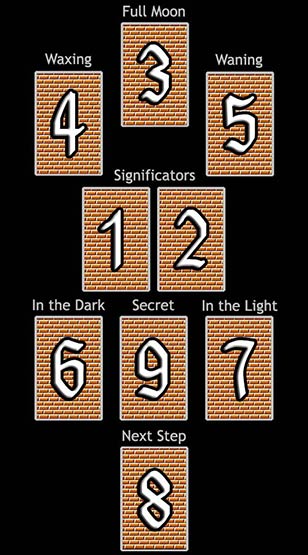
This spread makes a nice alternative to the Celtic Cross, which covers basically the same ground. It is useful when a question doesn’t quite call for the Ankh spread. This tarot spread is helpful for looking into a current trend. The High Priestess may or may not present a mysterious secret to be analysed after the rest of the spread.
1. & 2. Main impulses that represent the topic at hand. They may complement or oppose one another.
3. This is the current influence at this time.
5. The Waning Moon is the influence that is moving into the past.
4. The Waxing Moon indicates what is on the horizon, or the approaching influence. This is the immediate future.
7. The Light is what is clearly recognized, consciously.
6. The Dark indicates what is there but not fully perceived, though noticed on a deeper level of consciousness.
8. The Next Step is the near future, where this journey leads.
9. The final tarot card, only if it happens to be of the Major Arcana, reveals the Secret of the High Priestess. This is a special message that should be given added weight.
Comic Strip Spread
Difficulty: Easy
Note: This spread works best with decks like the Diary of a Broken Soul or Surrealist Tarot because they display scenes rather than pips and do not use reversals.
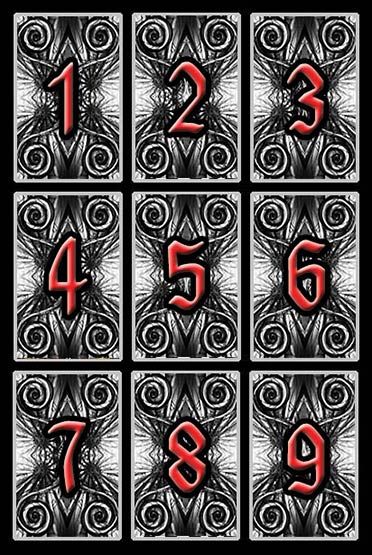
The Comic Strip Spread is a simple nine-card chronological spread that looks like a page of a comic book. This method should be used to get a glimpse of the future as it would pan out naturally. It may be insightful to use this spread in coordination with biorhythms. The spread is easy to read as a storyboard, just like a comic strip.
The main subject is apparent in the first card, while the story plays out through the following tarot cards.
It is important to pay particular attention to the cards and the relationships with their neighbours. Notice which directions the cards are facing, and how they interact.
Relationship Spread #1
Difficulty: Easy
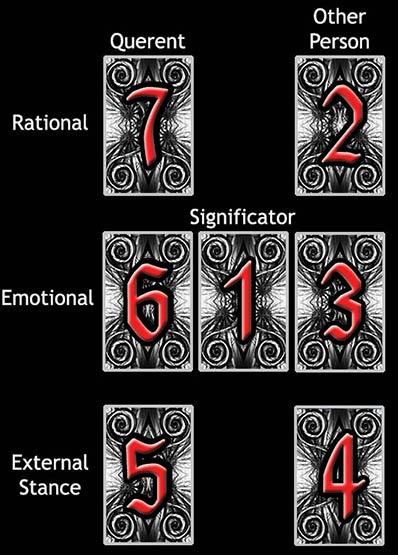
This tarot spread is easy to read, like a convenient chart. In this spread, court cards generally indicate actual people with the same characteristics. Knights (or corresponding princes, but not kings) and queens are meant to represent actual men and women in this tarot spread. Look for patterns in the cards as always.
Card #1 is the overall significator of the relationship. The two columns on either side of the significator characterise each individual’s role in the relationship. The relationship does not have to be romantic. In fact, it could be a relationship between a person and a group, or even how two groups relate.
The top row, cards #7 & #2, is about the conscious thoughts of each person, or what they think about the relationship and likewise how they view their partner.
The middle row, cards #6 & #3, reveals the way each individual feels about the other. Emotional awareness corresponds to a person’s unconscious thoughts that run deep, affecting a person in ways he or she is not fully aware of.
The bottom row, cards #5 & #4, represents the way each person behaves, in other words, the stance taken regarding the relationship. The way a person acts may be genuine, but sometimes people are phony and manipulative, so it is best to weigh this card against the other person’s cards to determine how they match up.
Relationship Spread #2
Difficulty: Easy
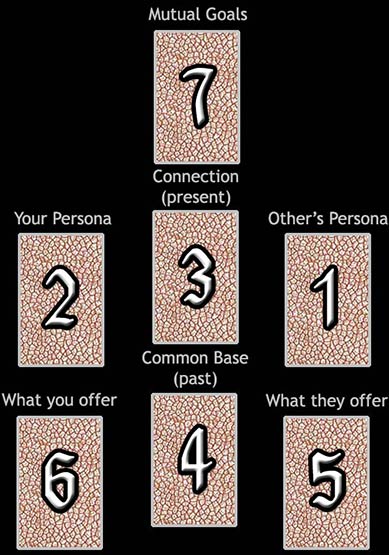
This relationship spread focuses more on the common ground of the relationship, with three cards in the middle column showing the common ground. The middle column essentially displays the past, present, and future of the relationship.
Card #4 stands for the common base of the relationship, which may be thought of as the past events which have shaped their characters, bringing them together. The current connection that binds them together is Card #3, indicating the values shared. Card #7 implies the common goals that would keep the pair together moving into the future.
The columns on either side show what each partner brings to the table. Remember, relationships need not be romantic, and the partners could even be groups rather than individuals. In this layout, the other person is on the left-hand side and the reader on the right.
Cards #1 & #2 indicate the separate personalities of each member of the relationship. These cards form a sort of bridge with the cards beneath them, #5 & #6, which show the qualities that each partner offers the other person, and thus to the relationship as a whole.
Advanced Layouts
The Love Triangle
Difficulty: Complicated
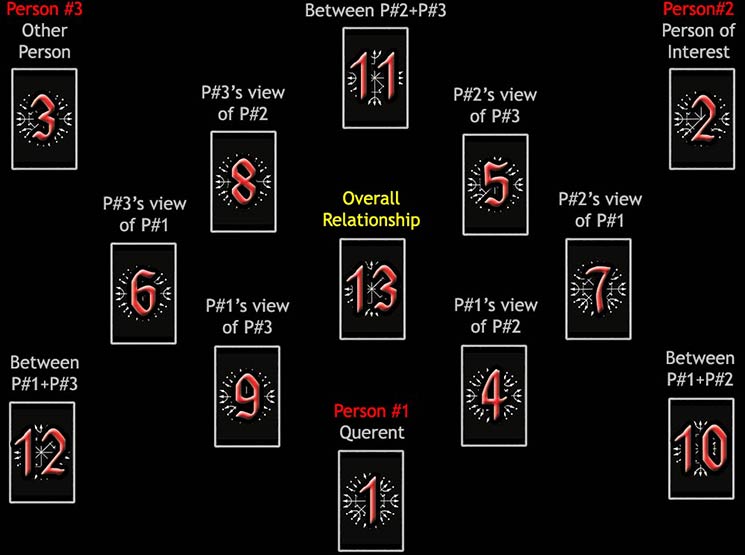
Casually referred to as the Love Triangle, this spread can be used to determine the dynamics of the relationship between three people, regardless of whether romance is involved. This spread is arranged in the form of a hexagram, consisting of several large and small triangles. This tarot spread may seem somewhat complicated, but it is not entirely that difficult.
The first step is to interpret the card for each individual position in the spread. Generally, one might ask about a relationship they are involved in, but this does not have to be the case. Ordinarily, the reader’s representative card is #1, their main person of interest is #2, and the other person would be #3.
The second step fills in the downward triangle and involves a further examination of the individuals through their views of other people. Each person has two more cards showing the way they see and relate to the other members of the triangle. For example, Card #6 indicates how Person #3 relates to Person #1, while Card #9 stands for Person #1‘s attitude toward Person #3.
The next step completes the upward triangle and the hexagram, focusing on cards #10–13. It also completes the many smaller triangles and hints at the potential for each relationship. The final card, #13 can be considered the significator of the reading, which suggests the overall potential for this three-way relationship.
The Decision
Difficulty: Easy
This simple but highly useful spread calls for a question to be asked in this format:
“What happens if I do (X), and what happens if I do not do (X)?“
Please note that it should not be viewed as a decision between two different options, but about whether a single option should be exercised or not. A second option would call for a separate reading.
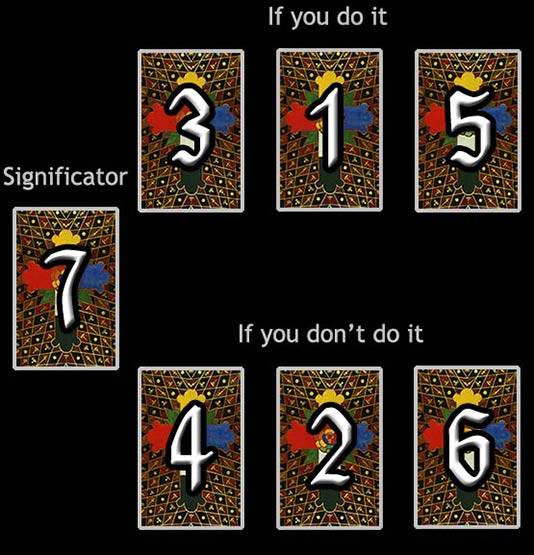
Card #7 is the significator, the overall theme of the query.
Cards #3, #1, & #5 represent the chronological sequence of events that occurs if the reader chooses to do (X).
Cards #4, #2, & #6 represent the chronological sequence of events that unfolds if the reader chooses not to do (X).
The Path Spread
Difficulty: Easy
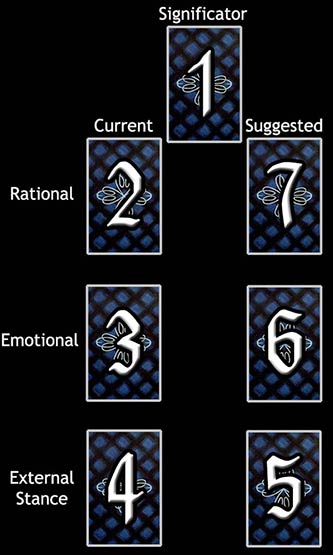
For the Path reading, one asks for suggestions on how to behave properly to achieve the desired result. The Current column represents how the reader has been acting, and the Suggested column suggests how they should act to achieve a certain goal. The chart-like spread uses the standard three levels: Rational, Emotional, and External Stance (how one projects oneself outwardly). When comparing the Current and Suggested cards, the most important thing is to notice the differences between the two cards. It is these differences that hint at the behaviours that should be altered.
Card #1 is the significator, the card which should reflect the nature of the query and/or the desired outcome.
Card #2 shows the way the reader is and has been thinking. Card #7 suggests how to change the way one thinks to serve themselves better.
Card #3 suggests the reader’s emotional attitude. Though it may seem difficult to manipulate one’s own emotions, it can be done if one puts their mind to it. For example, acting a certain way such as smiling intently for a few minutes will lead emotions to follow. When a person tries this, as silly as the exercise seems, they find this to evoke the emotion of happiness. For this reading, one should try to make themselves feel the way that Card #6 proposes.
External Stance means how one acts outwardly, and how they hope others see them. Card #4 is about how the reader has been acting, while #5 indicates how they should act outwardly, for other people’s sake. It is the differences between these cards that hint at what behaviour patterns should be altered.
The Game Plan
Difficulty: Easy
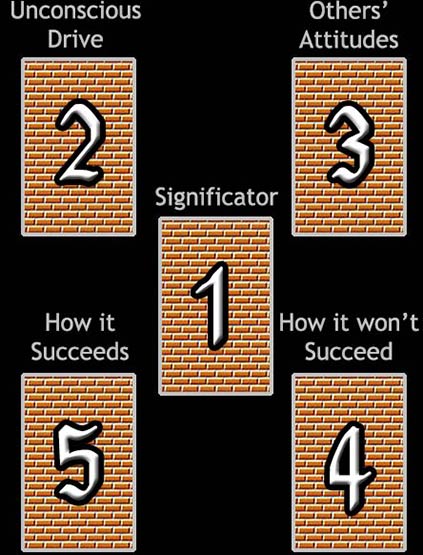
When a person has a certain plan in mind, this simple five-card spread presents a choice, hinting at what action or attitude should be taken for their plan to succeed, and what should be avoided to help the plan work out for the best.
The initial card is laid in the centre of the layout, the significator. The following four cards are laid out clockwise around the significator.
In this spread, the second card is about what drives the reader, but also says they are not fully conscious of this, perhaps even completely unaware of it. It provides a hint as to the reason they strive for their goal.
The third card uncovers what others think of the reader and their goals. The reader may or may not be aware of this. Sometimes other people factor into the plans (and sometimes they don’t).
The fourth card suggests what not to do. If things are permitted to go down this path, the plan will collapse.
The fifth card is a hint as to how to make this plan work out favourably. The idea this card presents should be followed to make the plan successful. The differences between Cards #4 & #5 should be noted, as the differences provide important clues.
The Astrological Spread
Difficulty: Complicated
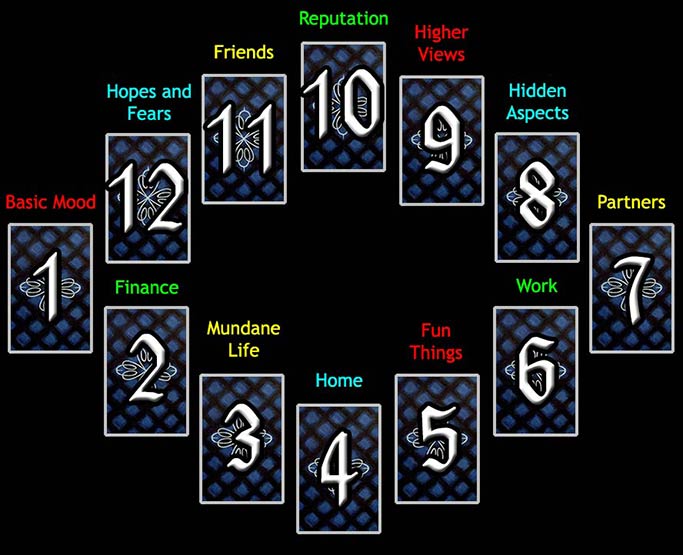
The Astrological Tarot Spread is based on houses of astrology. This complicated spread takes several steps to understand.
The first step is to interpret the tarot card for each individual position in the spread.
The second step involves a further examination of the main axes. Positions 1 & 7 show the relationship theme, #1 representing the reader, #7 their partner. Positions 4 & 10 indicate motion. #4 indicates where the reader is now, and #10 suggests what they are moving towards.
The third step involves breaking down the chart into triads according to their house elements.
Positions 1, 5, & 9 represent the Fire triad, symbolizing temperament and personal development.
Positions 2, 6, & 10 represent the Earth triad, concerned with materialism, money, and work.
Positions 3, 7, & 11 represent the Air triad, which has to do with thoughts, ideas, and connections with other people.
Positions 4, 8, & 12 represent the Water triad, the realm of emotions, moods, intuition, and yearnings.
Further, other patterns and correlations between certain numbers can be noted. Certain numbers such as the set of 5, 7, & 8 often speak about a particular theme.
The Self-Actualization Pyramids
Difficulty: Complicated
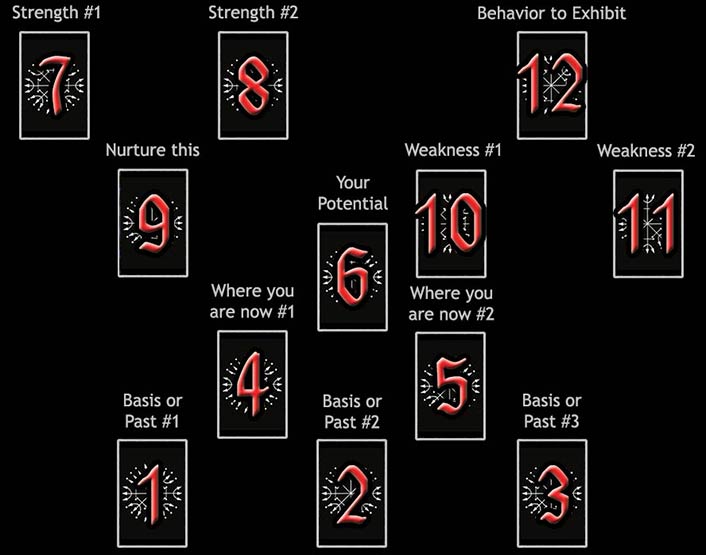
Basically, there is the main pyramid in the centre, and two smaller pyramids on each side. One is inverted.
Positions 1 & 3 represent where the reader comes from, or what has made them/shaped them on various levels. Can be from environment, upbringing, schooling, etc. A look at the past, but with more objectivity than is usually given when using tarot cards.
Positions 4 & 5 represent who the reader is right now. It May or may not make pleasant reading, but hey, this is what this is about, right?
Position 6 represents who the reader could be. Again, it might or might not look good, but a person can learn from that and change who they are accordingly. (This is a bit like how Scrooge did things in ‘A Christmas Carol’.)
Positions 7 & 8 are the reader’s strengths. This is the light they have, which can be bought to the forefront. What carries the person should not be hidden or unacknowledged.
Position 9 represents what should be given to oneself or created within.
Positions 10 & 11 represent personal areas for development or weaknesses. Again, might not make good reading, but if someone looks at their strengths first, they will be able to see a balance is there and can choose to focus on one side or the other. This is where a person could really see how their shadow side comes into play.
Position 12 represents what the reader should be offering externally, or what they can bring to their world or to others who inhabit that world.
The Golden Dawn Spread
Difficulty: Complicated
Note: Tarot decks that use reversed cards such as the Rider-Waite do not work well with this spread, which was designed to be read using elemental dignity.
The Golden Dawn spread is best suited for use with the bifrost Tarot and especially the Book of Thoth, as these decks are meant to be read a certain way with the court cards. Princes and queens represent actual men and women connected with the matter, while princesses generally represent ideas’;’ thoughts, or opinions, and knights represent the arrival or departure of a matter depending on the direction faced.
In this tarot spread, particular attention should be paid to a card’s exact position in relation to its neighbours. Whether the neighbour cards bear the same energy (suit) determines whether a card is considered well-dignified or ill-dignified. Opposite suits ill-dignify each other, while other suits are considered friendly. Tarot cards of the same suit or element strengthen each other.
As with other tarot spreads, it is important to count the cards’ tendencies, such as whether there is a lot of one particular suit or number pattern. The patterns reveal special messages. Having several majors present indicates higher forces at work, several cups suggest strong emotions, etc.
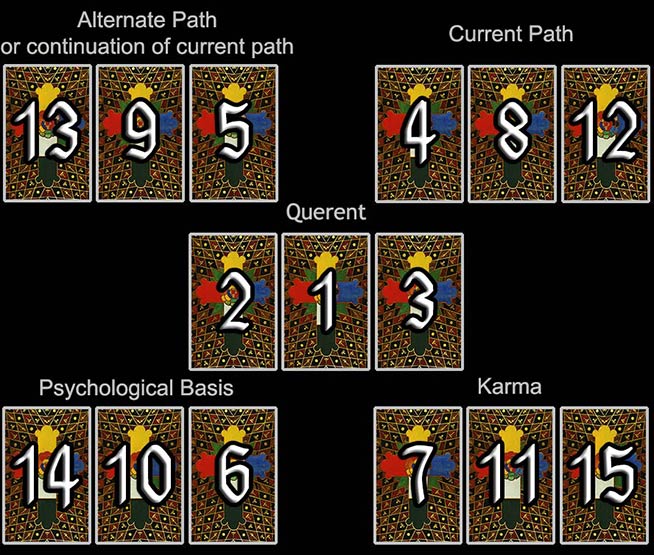
Card #1 represents the reader and the nature of the topic at hand.
Cards #2 & #3 are read as an extension of #1 to further comprehend the nature of the topic.
The two sets of three tarot cards at the top of the spread represent chronological sets of events. The current path as it would unfold naturally is represented by cards #4, #8, & #12. The alternate path that could be taken is represented by cards #13, #9, & #5. However, if the reader gets the feeling these cards are telling them they go together, then the alternate path is to be considered an extension of the current path, and to be read chronologically in this order: #4, #8, #12, #13, #9, #5. Just keep in mind: this is only if the two paths seem particularly similar.
Cards #14, #10, & #6 shed light upon the psychological undertones of the current issue.
Cards #7, #11, & #15 represent the influences of karma and destiny beyond the reader’s control. These cards suggest adapting to this, as fate.
The layouts below are for use with Mahjong divination.
3 Bones
Difficulty: Easy
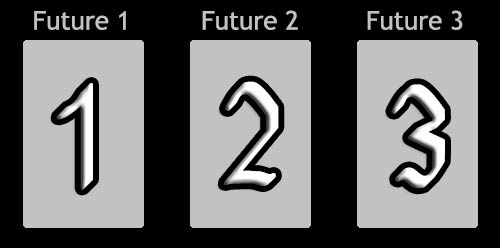
This layout is used only for mahjong tiles and dominoes, drawing three tiles. The tiles are flipped to answer the question in chronological order. There are two methods that can be used, either proceeding with the reading as normal or placing each tile back in the pile so that it could possibly come up more than once. If tiles repeat, this would indicate a faster or more potent outcome.
The Reversed Compass Layout
Difficulty: Hard
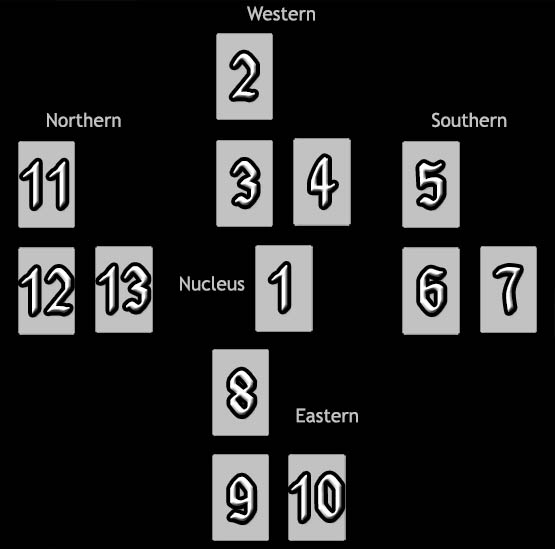
This reading sets the tiles in the celestial form instead of the terrestrial format that is used in navigational compasses, following the traditions of Chinese philosophy. This complex reading is very flexible in that one may focus on a specific or general question, or no question at all when using it.
In the Reversed Compass Reading, each of the sets of tiles has an influence on the issue represented by the nucleus. To interpret this reading properly, all the tile sets should be compared to the nucleus.
The Three Dragons
Difficulty: Moderate
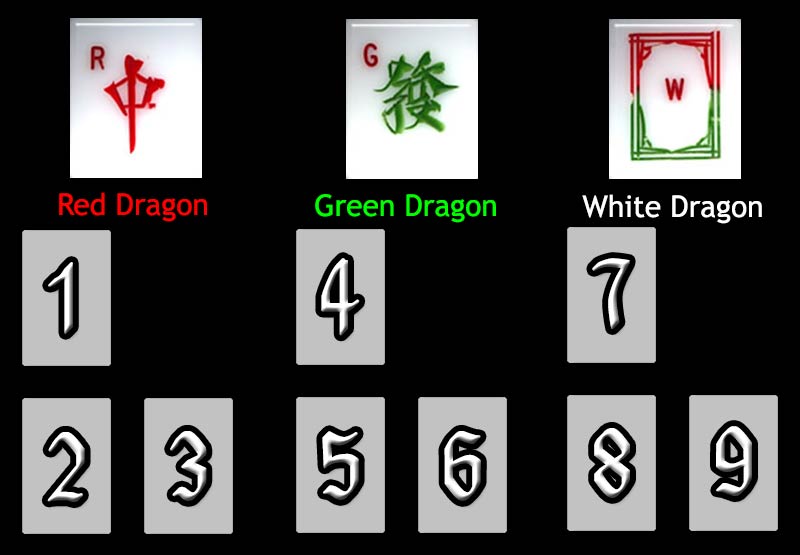
In Chinese culture, the dragon is considered a sign of great luck and power. However, in mahjong, red, green, and white dragons represent three distinct influences that can affect a person’s life. The Dragon Reading creates a relationship between sets of tiles for each dragon, to explore how the three dragons will influence things now and in the near future.
‘Secret of the High Priestess’ spread by Hajo Banzhaf
‘Love Triangle’ spread by Jeremy Lampkin
‘Self-Actualization Pyramids’ spread by Davina Powell